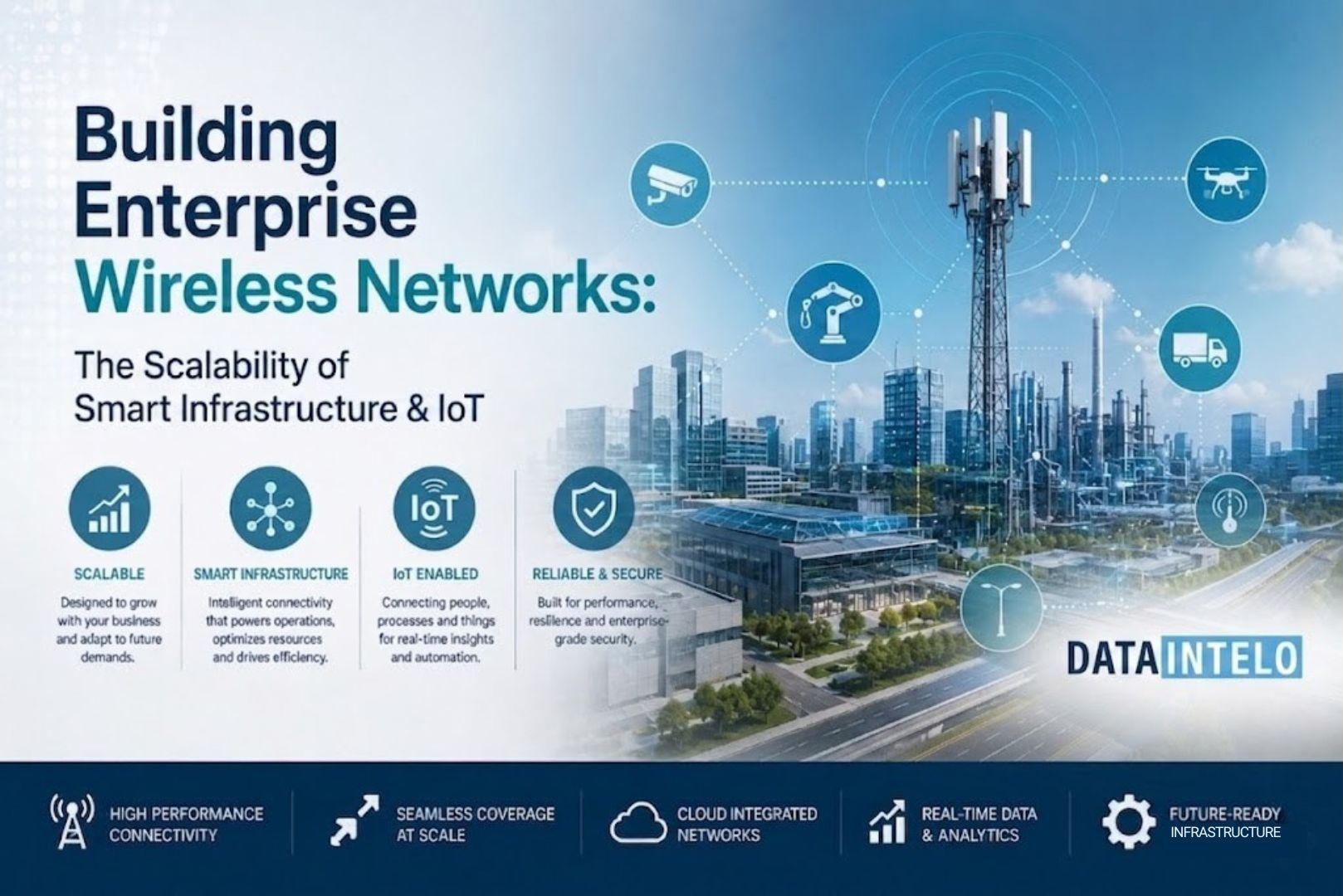
Digital transformation is happening lightning fast worldwide, making smart infrastructure and IoT connections super crucial. Enterprise wireless networks really help with that. Also, the global smart infrastructure market is doing amazing. It's projected to be worth over $55 billion by 2026 and jump to $120 billion by 2032, that's a strong 11.5% CAGR.
Image Title: Building Enterprise Wireless Networks: The Scalability of Smart Infrastructure & IoT. Image Credit: Data Intelo https://dataintelo.com/
Key Statistics
Metric
2024
2025
2026
2030
2033
CAGR
Global IoT Market Revenue
USD 428 billion
USD 445.3 billion
USD 462 billion
USD 750 billion
USD 934 billion
16%
IoT Connected Devices
18.5 billion
20 billion
22 billion
30 billion
35 billion
14%
Enterprise IoT Market Size
USD 354 million
USD 385 million
USD 403.69 million
USD 620 million
USD 774.54 million
13.92%
Enterprise IoT Market Size
USD 354 million
USD 385 million
USD 403.69 million
USD 620 million
USD 774.54 million
13.92%
LoRaWAN Deployed Devices
100 million
125 million
145 million
250 million
380 million
25%
In-building Wireless Market
USD 19.2 billion
USD 21.5 billion
USD 23.6 billion
USD 42 billion
USD 60.2 billion
12.2%
Enterprise WLAN Market
USD 22.5 billion
USD 24.8 billion
USD 27.98 billion
USD 68 billion
USD 50.53 billion
12.55%
IoT Use Case Adoption by Industry Vertical
Industry Vertical
Market Share
Primary Use Cases
Growth Rate
Retail & Wholesale
28%
Asset Tracking, Inventory Management, and Smart POS
IoT has grown way past just being a new tech gimmick. It’s now a key part of how companies operate – whether that's utilities, factories, smart buildings, or farms. These businesses aren't talking about it anymore; they've got hundreds or even millions of IoT devices actually running things.
Spending on Enterprise IoT has kept growing steadily for the last few years. This means the industry has really bounced back from its earlier slump. With spending growing at a healthy 13.92% each year through CAGR, all the cool trends in this space are here to stay.
Looking at the numbers, it’s pretty exciting. The market for in-building wireless systems ended last year at $21.5 billion and is just blowing up in 2026. Experts think this sector will be worth over $60 billion by 2034. That’s more than doubling! With a CAGR of 12.2%, you know it’s not just a quick burst – it’s a real growth trajectory.
Market Growth and Adoption Trends
The Enterprise WLAN Services Market gives us a peek into the trends shaping up the wireless infrastructure scene. By 2034, LoRaWAN technology is forecasted to be worth $19.24 billion, growing at a 9.2% annual clip. It's experiencing major growth due to increased deployments recently.
The global IoT connectivity market is projected to reach $40.8 billion by 2030 and $52.9 billion by 2035, according to analysts. Leading the charge is the utilities sector, driven mainly by smart water metering. Besides, LoRaWAN is now the top choice for making buildings smart.
As for Cellular IoT, it's on a roll too. After hitting 4.5 billion connections last year, it's expected to jump to about 4.8 billion in 2026. By 2031, Cellular IoT will keep rising, reaching over 8 billion active links – that's a 10% yearly increase. Of the bunch, broadband IoT using 4G and 5G accounts for roughly 60% of all Cellular IoT connections.
Key Technologies Enabling Scalability
The rise of long-range, low-power wide-area networks (LPWANs) has made digitalization a lot simpler and has made IoT accessible to companies of all sizes. There are several choices out there, like LoRaWAN and mioty™, allowing businesses to pick what works best for them.
A Network Management System is key for expanding IoT solutions. Today’s systems have lots of features such as security, scalability, and flexibility. They use AES 128 end-to-end encryption and TLSv 1.2 for transport security. It can scale up too, from local spots to whole countries, with thousands of gateways and millions of devices.
Integration skills are key to scalability too. APIs on platforms today use protocols like MQTT, HTTPS, WebSockets. They can connect to major cloud services including Amazon Web Services IoT, Azure IoT, Google Cloud IoT Core and IBM Cloud. It gives users real flexibility to choose cloud-based configurations or to stay with on-premises ones.
Primary Growth Drivers
There are several key things driving enterprise wireless network adoption around the world. Private 5G networks and indoor connectivity systems play a huge role. Plus, regulations for public safety and building upgrades are making everyone use certain communication protocols. This leads to more demand for indoor connectivity solutions.
AI integration is also a major force behind this growth. Many new IoT products now include AI thanks to cloud and edge computing. This allows real-time data processing. The software powering IoT—Infrastructure-as-a-Service and Software-as-a-Service—is booming, growing over 20% annually. Sustainability drives things too. This is boosting investments in IoT for energy, utilities, and smart infrastructure. Things like smart water management, lighting, and building systems not only help the environment but also cut costs. The smart manufacturing sector is the quickest growing part of IoT right now, thanks to Industry 4.0 efforts.
Architectural Requirements for Enterprise Scale
Enterprise-level wireless networks have to use carrier-grade systems to provide reliable infrastructure for big-scale operations. This involves lots of gateways, base stations, and devices needed for business apps. If firms want to grow their IoT set-up but skip carrier-grade stuff, troubles will follow.
Securing the network is key and has to be built in right from the start. Protecting IoT stuff is an ongoing thing from when they first get set up until they're running. Encrypting data with protocols and secure transport methods stops sensitive info from being compromised.
When setting this all up, businesses must think about scaling up ops. While you might begin with fewer than 1,000 devices, most final deployments see way more – usually around 10,000. Last year only 8% of cellular IoT rollouts hit 10,000, yet by 2026 it shot up to 27%, showing a huge growth in big IoT setups.
Application Areas and Use Cases
Enterprise wireless networks have a ton of uses across various industries. For instance, LoRaWAN tech powers much of smart water metering, which keeps tabs on water usage, spots leaks, and tracks quality.
In smart buildings, we get benefits like checking indoor air, optimizing lighting, and tying everything into Building Management systems. Asset tracking also gets a boost, think animals, vehicles, and cold chain stuff.
Plus, industrial IoT grows too, with perks like keeping an eye on structural health, refinery flows, and factory smarts.
So, it’s clear these networks open up all sorts of helpful applications in real-world settings.
Industrial IoT, Smart Infrastructure, China & India Growth
Rest of World
9%
12%
Emerging Markets, Smart Agriculture, Utilities
Future Outlook and Strategic Considerations
Scaling smart infrastructure and IoT is no longer a technical problem to be solved, it’s a business imperative. Companies that have put network management systems in place that focus on safety, flexible protocols, and the cloud have gone from proof-of-concept projects to fully operational ones.
Plus, keep an eye out for some key trends developing. Machine learning will optimize network settings and save battery power. Plus, there's the rise of edge computing, which reduces the need for cloud and cuts down latency. Then, there's the use of private 5G to back low-power wide-area networks.
The worldwide market size for IoT connectivity is expected to amount to $40.8 billion in 2030 and reach up to $52.9 billion by 2035. The growth will come from the usage of IoT technology in corporate settings like smart Building Management and factory automation, which will make up 65% and 69% of all connections, respectively.
In order to capture these benefits for their bottom line and the planet, businesses will need to focus on reliable networking solutions that are secure, scalable nationally, and can utilize several protocols along with working with the cloud. Those that do will be in a much better spot to cash in on all the IoT has to offer.