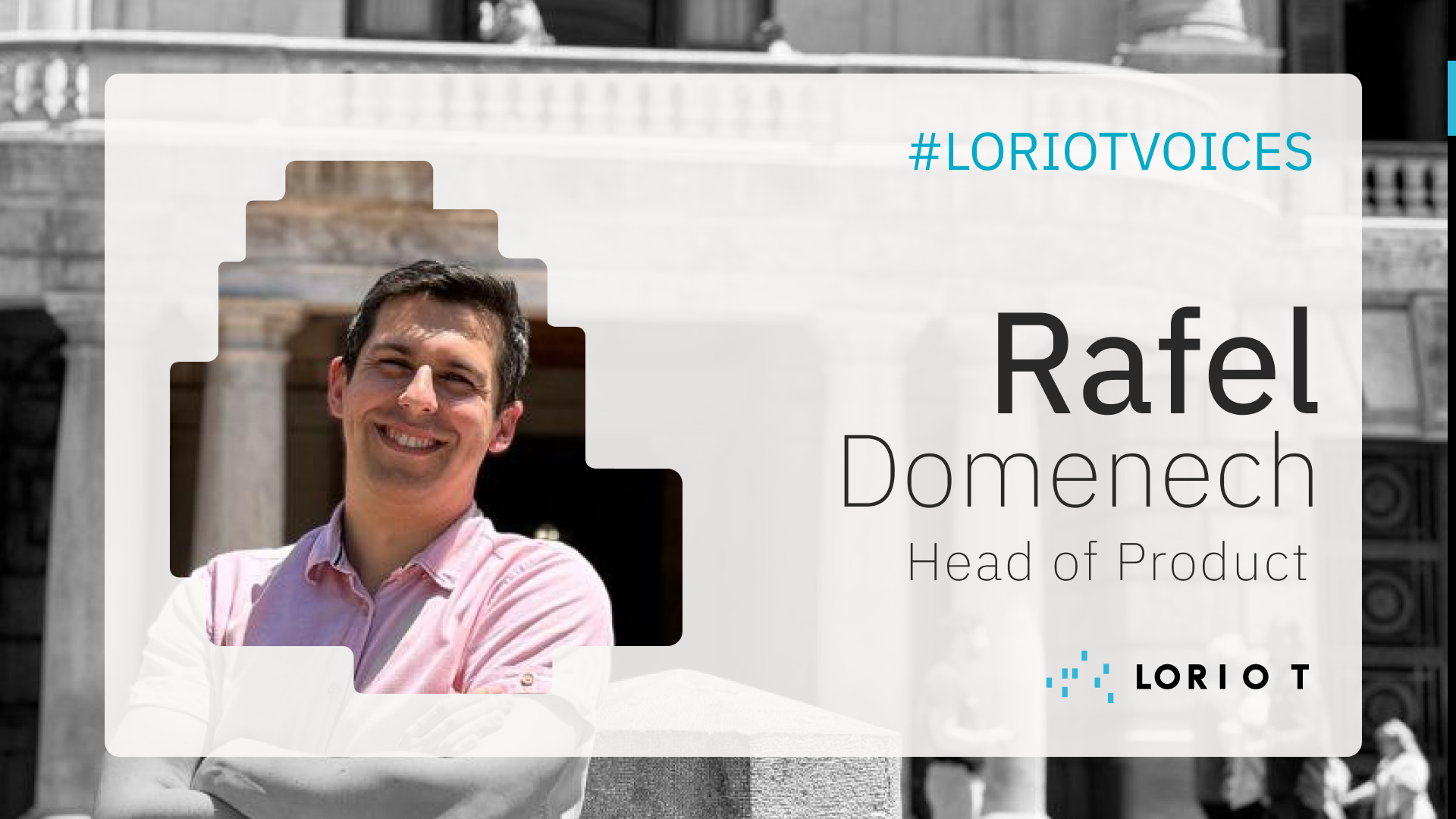
"An excellent IoT product helps customers solve issues they didn't know they had."
In our new #LORIOTVoices series, we're taking you behind the scenes to explore the world of IoT through the perspectives of the professionals shaping this industry.
For our inaugural interview, we sit down with Rafel Domenech Peiró, our Head of Product, to explore how IoT has transformed, what makes products truly valuable, and why understanding diverse perspectives is crucial for building solutions that matter.
1. What originally drew you to work in IoT, and what keeps you passionate about this field?
I’m an engineer first and foremost, so I’m always curious about technology and how it can be used to improve the different aspects of our lives. Understanding the real, tangible advantages and improvements that IoT provides is a huge motivator.
2. For readers who might be new to IoT, what's the simplest way to explain what a Network Management System does and why it matters?
A Network Management System is a key component of the IoT infrastructure; its role is to ensure that the right data flows to the right place. It forwards the data from the sensor devices on the field to the visualization platform in the cloud and makes sure that messages from the user or application server reach the end-devices; all the while handling the MAC layer communication that is mostly invisible to the end-user.
LORIOT takes this core functionality further with our hybrid network management approach, supporting both LoRaWAN® and mioty®. This allows you to leverage the strengths of different LPWAN protocols within a single platform, choosing the most suitable technology for each specific use case while maintaining unified network management.
3. Many companies and professionals still find IoT intimidating. How can we make these complex technologies more approachable for non-technical teams?
I think it’s important to understand that not every technology is suited for every use case, but also that the customer profile has changed a lot since IoT’s humble beginnings.
"IoT is no longer a gimmicky way for engineers to play with technology but a whole industry that provides solutions to all types of businesses, institutions, and industries."
IoT solutions must take this into account to meet the evolving customer needs; providing end-to-end solutions, user-friendly applications and easy-to-install hardware are just the first basic steps.
4. How does bringing together different perspectives help when developing technical products?
Having multiple perspectives is essential when designing and developing a product, or you risk a metaphorical tunnel vision that won’t allow you to see the problems and missed opportunities.
As Head of Product, I rely on the expertise and perspective of colleagues and partners to make informed decisions and guide the product development in the direction that best aligns with the needs of the stakeholders. This involves discussing new technological requirements with our Chief Research Officer, Béla Márkus, reviewing User Experience enhancements with our designer, Manel Almenar Cardona, and analyzing customer requests alongside Manuela Schlereth, Head of Technical Account Management, and Noémi Bartalis, Head of Support.
Additionally, I often meet directly with our customers and partners to explore future improvements and gain a deeper understanding of the challenges they face.
5. In your opinion, what principles make an excellent IoT product when the market offers so many possible directions?
An excellent IoT product is one that not only saves the customer money and solves an issue, it also helps the customer solve issues they didn’t know they had. Versatility is key, and allowing customers to adapt to their different needs and use cases will ensure customer loyalty and satisfaction more effectively.
We apply this principle through all the stages of our product development, offering a flexible architecture that adapts to various use cases, from PoCs to massive deployments, all within the same platform.
6. How have you seen customer needs in IoT networking change over the past few years?
"What began as a novelty for hobbyists and curious engineers has now transformed into a technology that attracts significant investment from telecommunications experts who see great potential."
Today, most customers are no longer seeking technology to tinker with; instead, they want effective solutions to specific problems, making the technology itself almost irrelevant.
This is also clearly reflected in the way our product has evolved. We started with our Public Community Servers and monolithic private server installations, but we quickly added redundant server models and SaaS offerings. We've expanded our cloud services to feature distributed servers with SLA guarantees, enhancing the product's capabilities to support our customers as they grow their business cases. We've also incorporated more features tailored to the interests of our enterprise clients and partners.
Naturally, we also improved our internal processes along the way to a very high degree of maturity with a special focus on Quality and Security, as evidenced by our ISO 9001 and ISO 27001 certifications.
From network management fundamentals to understanding what customers really need, there's clearly much more to unpack when it comes to building IoT solutions that truly make a difference.
What questions would you ask Rafel Domenech Peiró about IoT product development? Whether you're curious about technical challenges, customer insights, or industry trends, drop your thoughts in the comments—we'd love to continue the conversation and explore the topics that matter most to you.